Lightweight 3D Object Detection via Mamba-Based Knowledge Distillation
Abstract & Contributions
Research Summary
3D object detection using LiDAR sensors requires a balance between computational efficiency and accuracy for onboard perception in autonomous driving and robotic navigation. Many existing LiDAR-based detection methods employ complex architectures to extract features, integrating large amounts of contextual information to enhance accuracy. This often results in significant computational costs, leading to suboptimal performance on resource-constrained embedded devices. In this study, we propose a knowledge distillation framework that transfers object-level voxel representations from a strong teacher model to lightweight student models through selective voxel-space feature alignment. Taking advantage of the linear-time sequence model with selective state spaces (Mamba), we design a multi-branch Mamba teacher backbone and a box-aware feature transfer mechanism that aligns spatially corresponding voxel features between teacher and student networks through a Mamba-based projection module. Experimental results on both a public dataset and real-world data show that our approach significantly reduces computational load while maintaining competitive accuracy compared with state-of-the-art methods.
Key Contributions
- 1
We propose a novel Multi-branch Mamba 3D Backbone as a high-capacity teacher model, integrating Shallow and Deep Mamba branches to enhance multi-scale feature representation from sparse LiDAR point clouds.
- 2
We introduce a Mamba Adaptive Distillation strategy with a box-aware feature transfer mechanism that selectively aligns voxel features within ground-truth 3D bounding boxes, enabling effective knowledge transfer to compact student models.
- 3
We reformulate the Cost-Performance Ratio (CPR) metric by incorporating inference latency, providing a more deployment-relevant measure of model efficiency on embedded robotic platforms.
- 4
We collect and validate on a real-world proprietary dataset (Livox-Legged) using legged robots equipped with Livox Mid-360 LiDAR sensors, demonstrating practical deployment on an NVIDIA Jetson Orin NX at ~3 Hz.
Proposed Distillation Methodology
We bridge the gap between heavy multi-branch Mamba models and compact, prunable detectors through selective voxel-space feature alignment and coordinate-consistent distillation.
Selective Voxel-Space Distillation
Directly transferring voxel representations between teacher and student networks is challenging due to differences in feature dimensions and sparse spatial layouts.
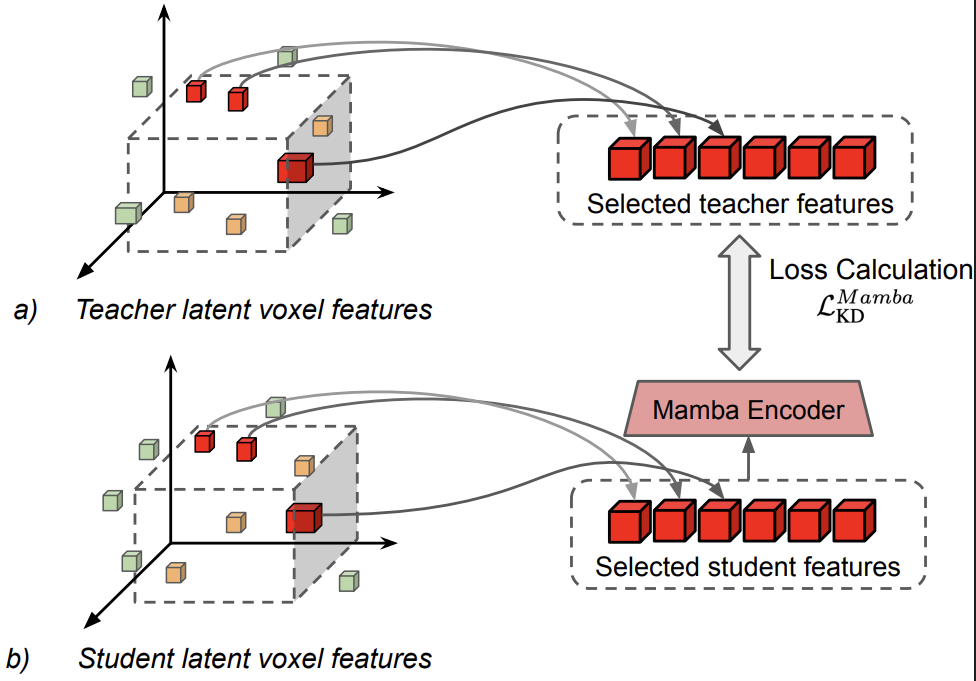
To address this, our framework extracts intermediate Mamba block features and isolates common voxel indices that lie inside the ground-truth 3D bounding boxes. By focusing on active object voxels, we mitigate point cloud sparsity issues and suppress irrelevant background noise during knowledge transfer.
1. Voxel Partition & Sequence Ordering
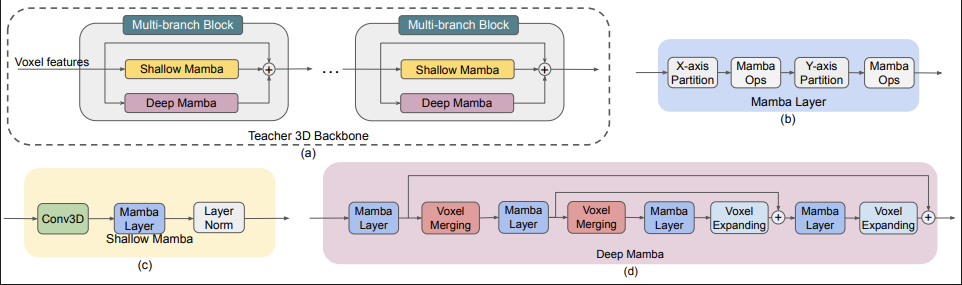
Sparse 3D voxel grids are grouped and arranged sequentially along orthogonal directions (X-axis and Y-axis partitions) to preserve spatial locality while forming 1D sequences.
2. Multi-Branch Feature Extraction
A parallel architecture featuring a Shallow Mamba branch for low-level features and a Deep Mamba branch with voxel merging and expanding to capture high-level spatial context.
3. Box-Aware Latent Alignment
Feature alignment is applied selectively to common voxel indices within ground-truth 3D bounding boxes to prioritize semantic object regions and ignore background noise.
4. Mamba-Based Projection
A lightweight Mamba encoder acts as a projection module, mapping student voxel representations into the higher-dimensional teacher feature space for loss calculation.
Model Architecture
Detailed structure of the proposed Multi-branch Mamba 3D Backbone (teacher model).
Dual-Branch Voxel Feature Learning
The core teacher architecture consists of stacked **Multi-Branch Blocks (MBBs)**. Each block integrates a **Shallow Mamba branch** and a **Deep Mamba branch** in parallel.
The **Shallow branch** employs standard Mamba layers combined with 3D sparse convolutions to extract low-level geometry, prioritizing computing speed.
The **Deep branch** utilizes voxel merging and expanding operations interleaved with Mamba sequence sweeps to capture high-level global context and long-range structural dependencies.
- Stacked MBBs: Robust multi-scale representation of point clouds.
- Orthogonal Sweeps: Structured sequence scans along both X and Y directions.
- Residual Fusion: Outputs from parallel branches are merged and fused.
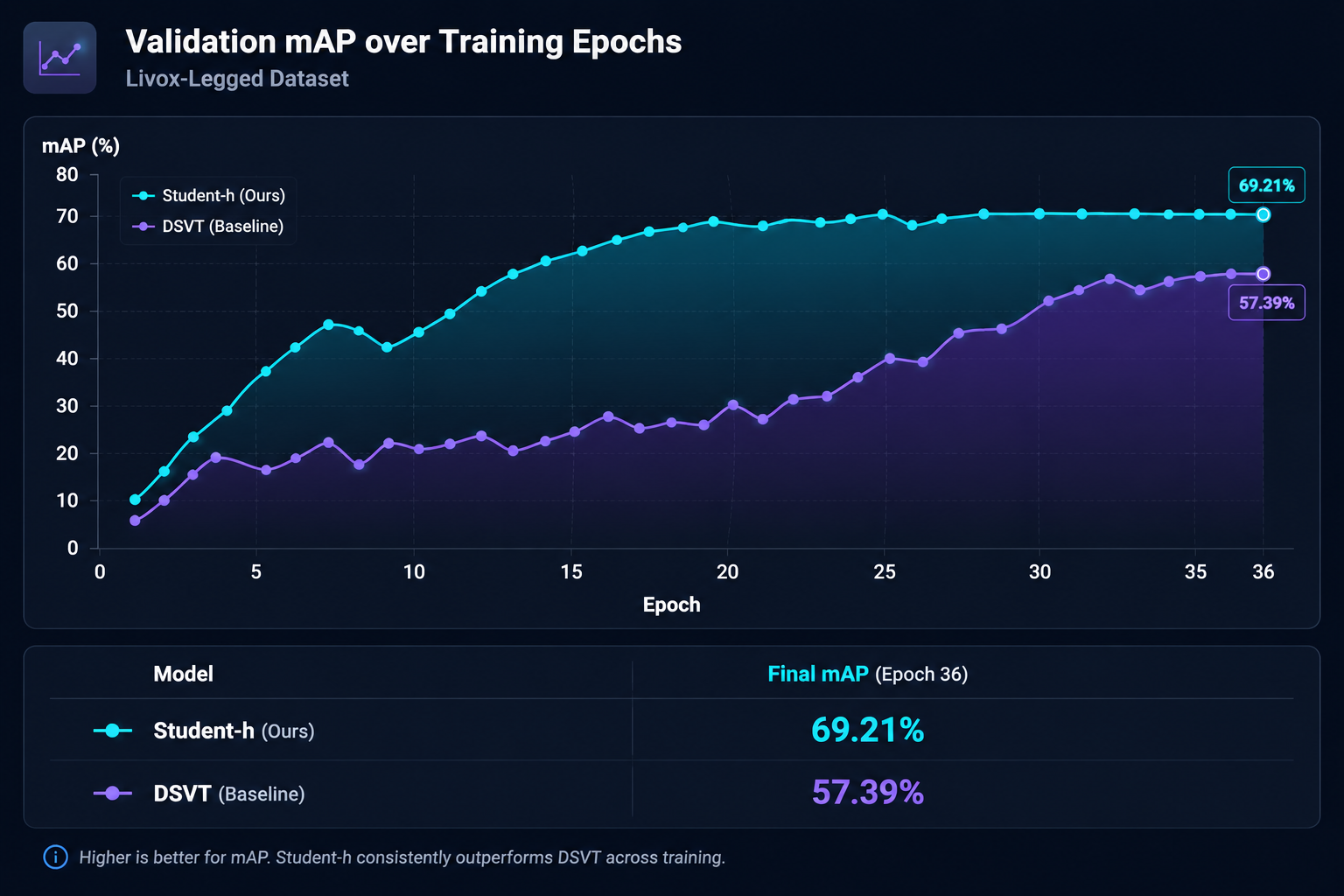
Livox-Legged Validation Results
Per-class AP performance and 3D bounding box predictions on the real-world Livox-Legged test dataset. Latency measured onboard our Jetson Orin NX robot platform.
nuScenes Quantitative Benchmark
Detailed performance comparison on the nuScenes validation set. Latency measures the model execution on a single NVIDIA RTX A4000 GPU under identical settings.
| Model | Params (M) | Latency (ms) | nuScenes mAP (%) |
|---|---|---|---|
| CenterPoint [13] | 5.98M | 26 ms | 59.2% |
| VoxelNext [27] | 19.05M | 46 ms | 60.5% |
| Transfusion-L [28] | 8.38M | 67 ms | 64.6% |
| DSVT [14] | 8.20M | 84 ms | 66.4% |
| Voxel Mamba [6] | 22.35M | 230 ms | 67.5% |
| LION [5] | 16.52M | 185 ms | 68% |
| Teacher Model (Ours) | 23.52M | 199 ms | 68.2% |
| Student-d (Ours)Student | 11.04M | 108 ms | 67.9% |
| Student-g (Ours)Student | 10.50M | 97 ms | 67.1% |
| Student-h (Ours)Student | 4.11M | 71 ms | 65.6% |
Legged Robot Patrol Deployment
We deploy and test the lightweight Student-h model on a physical legged patrol robot in a pedestrian-aware navigation scenario to evaluate real-world perception.
Multi-Sensor LiDAR Calibration
Multiple Livox Mid-360 LiDAR sensors are mounted on the legged robot. Point clouds from all sensors are spatially calibrated and merged into a unified spatial representation.
Pedestrian-Aware Patrol Navigation
The robot operates in outdoor navigation scenarios. The distilled model accurately detects pedestrians, cars, and motorcyclists to ensure obstacle-free routing.
Motion Planner Integration
3D detection bounding boxes are fed directly to the robot's local trajectory planner, enabling it to execute a safe stop when an obstacle enters its forward path.
Embedded Jetson Onboard Execution
Our optimized student-h model runs directly on the NVIDIA Jetson Orin NX platform, achieving deployment latency suitable for low-speed autonomous patrolling.
How to Cite
If you find our work or code useful in your research, please cite our RA-L paper.
@ARTICLE{11631859,
  author={Ninh, Quoc Cuong and Pham, Huy Xuan and Nguyen, Anh Tung and Trinh, Dinh Hoan},
  journal={IEEE Robotics and Automation Letters},
  title={Lightweight 3D Object Detection via Mamba-Based Knowledge Distillation},
  year={2026},
  pages={1-8},
  doi={10.1109/LRA.2026.3719203}}